

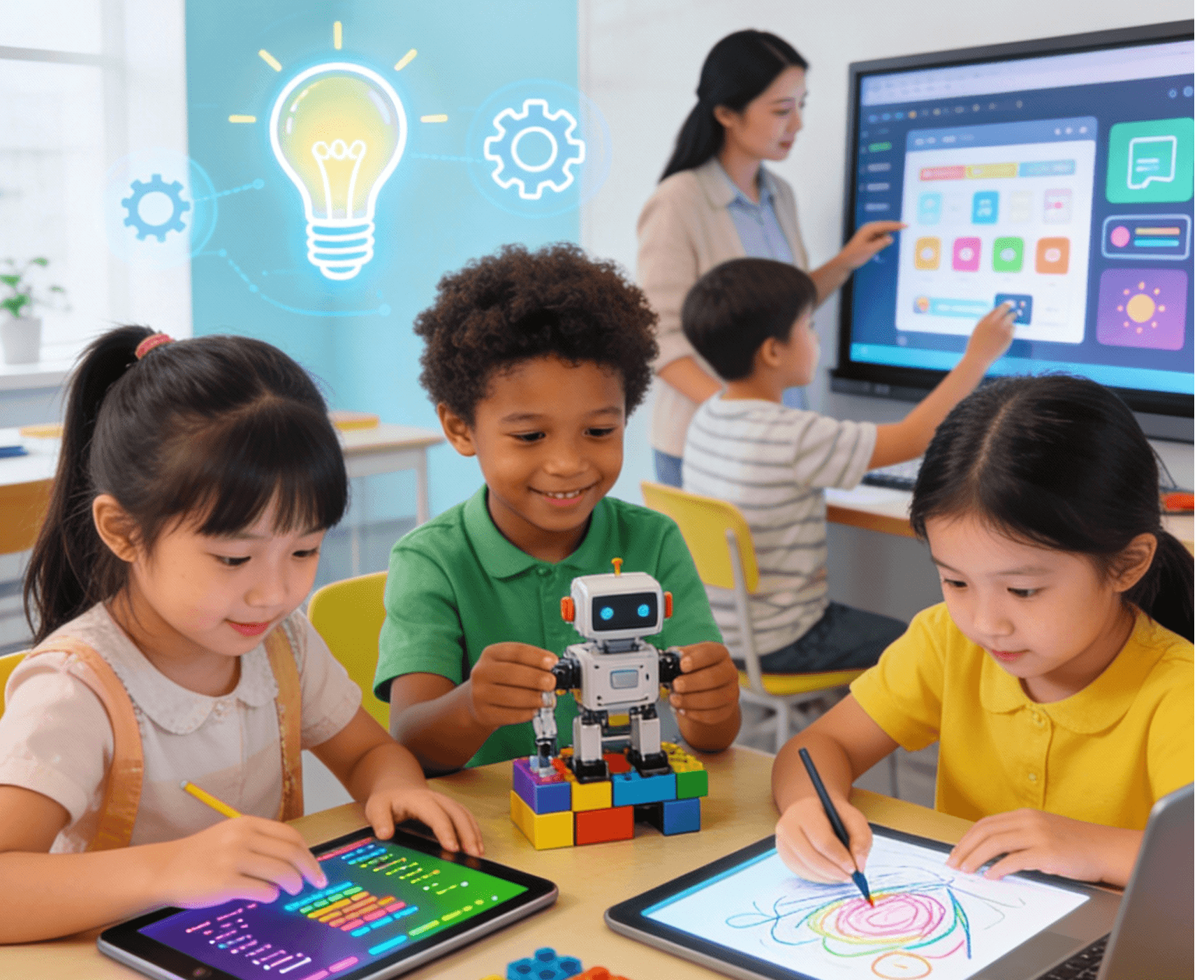
Introducing children to Technology at a young age…
Introducing children to technology early, thoughtfully and with supervision, helps them see digital gadgets not as entertainment machines but as tools that expand what they can do. They need to understand that the goal isn’t just to make life “easier” in the sense of avoiding effort. It’s to make certain tasks more workable, comfortable and to focus the effort on curiosity, problem-solving, and creativity.
Why early exposure matters…
- Technology is the language of the modern world and it is part of our daily life: communication, navigation, learning, and work. Early familiarity is like learning a second language in childhood.
- Using tools like cameras, maps, note apps, and coding apps teaches sequencing, cause-and-effect, and systems thinking.
- Children who learn to produce, not just consume, view technology as something they can shape, not something that shapes them.
Tools, not shortcuts…
Children must learn that technological tools:
- Reduce friction, not effort… A calculator speeds arithmetic but doesn’t replace number sense. A spell-check suggests corrections, but the child still owns the sentence.
- Extend capability… A measuring app or a simple robotics kit lets kids build and test ideas they couldn’t before.
- Require judgment… Searching is fast; evaluating sources takes thinking. The tool is efficient, the user must be discerning.
“The tool does the simple parts so I can focus on the hard parts.”
Age-appropriate pathways…
We could try to distribute things depending on the age of each child and I will try to illustrate this a little bit here:
Ages 3–6: Exploration and cause-and-effect.
- They can start taking photos, use drawing apps, listen to audio-books, interact with voice assistants for questions.
- They will improve their motor control, naming and categorizing, asking clear questions.
- It should always be co-used with an adult during short sessions.
Ages 7–9: Creation over consumption.
-
- They can start using block-based coding (Scratch), exploring simple robotics, using kid-friendly note-taking apps, making slides to tell a story.
- They will learn sequencing, debugging, planning and presenting.
- Parents should goals before screen time.
Ages 10–12: Independence with supervision.
- They spend more time using document editing apps, basic spreadsheets, researching with source evaluation, elaborating web projects and editing photos/audios.
- This will teach teach them project planning, data literacy, versioning and digital skills.
- It is time to discuss online safety more seriously.
Supervision…
- Sit together at first and co-use with them and not just coach.
- They should use family accounts, be introduced to device downtime, be surrounded by content filters, and use shared spaces for devices.
- As a ritual and not just a rule, screens should stay out of bedrooms.
The lesson underneath…
Kids should be taught that technology offers leverage, not an escape. It amplifies attention, habits, and integrity. Kids who learn to use tools intentionally discover that comfort comes from removing boring and unnecessary tasks, while real learning still takes effort.
\”Tools are there to aim higher, not to avoid the climb\”
Guiding them at a young age does not give them a shortcut in their childhood. They learn how to remove friction through the many tools they have access to, but still teaches them that thinking is still they key everything.
Aimé
… and remember : A Challenge a day, keeps failure away.
Tags: